
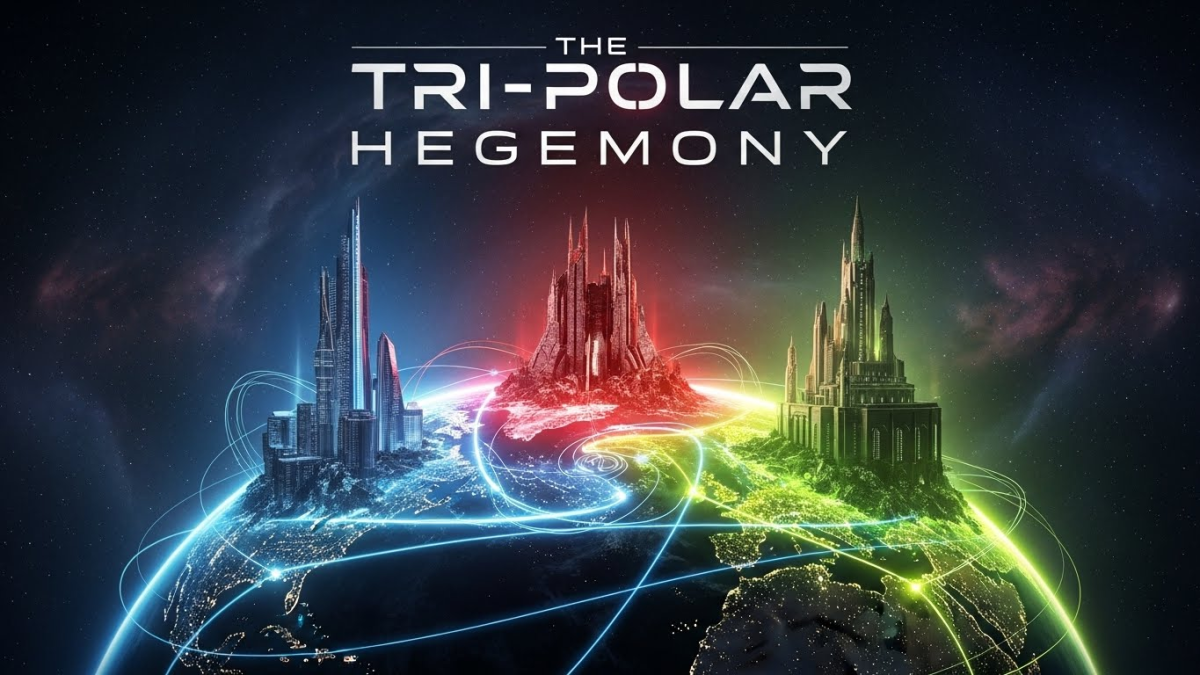
The Tri-Polar Hegemony: A Comparative Treatise on the Architectural, Algorithmic, and Epistemic Divergences of Frontier AI Laboratories
Abstract
The mid-2020s mark a pivotal transition in the history of artificial intelligence, characterized not merely by the intensification of computational scale, but by a fundamental "speciation" of the dominant research entities. The monolithic pursuit of "Scaling Laws" (the observation that increased compute and data logarithmically yield increased intelligence) has fractured into distinct phylogenetic branches. This report provides an exhaustive, academic analysis of the three hegemonic powers defining this era: OpenAI, Google DeepMind, and Anthropic. By dissecting their strategies across three critical pillars (The Software & Silicon Substrate, The Mathematical & Algorithmic Paradigm, and The Epistemic & Communicative Governance), we argue that these organizations are no longer competitors running the same race, but distinct schools of thought constructing fundamentally different classes of synthetic intelligence. OpenAI pursues the "Thermodynamics of Reasoning" through massive centralization and inference-time compute; Google DeepMind relies on "Vertical Integration" to achieve native multimodality and scientific utility; and Anthropic champions "Epistemic Transparency" through mechanistic interpretability and hybrid infrastructure. This divergence shapes not only the technical trajectory of AGI but the geopolitical and societal fabric of the 21st century.
Part I · The Software & Silicon Substrate: The Infrastructure of Cognition
To understand the mind of the machine, one must first understand the anatomy of the body that houses it. The "software" and "hardware" strategies of the frontier labs are not merely logistical details; they are the physical manifestations of their strategic philosophies. The constraints of electricity, bandwidth, and latency dictate the boundaries of cognition.
1.1 OpenAI and the "Stargate" Paradigm: The Centralization of Compute
OpenAI’s infrastructural philosophy is defined by a singular, overwhelming ambition: the consolidation of maximum computational density into a monolithic entity. This strategy is realized through their symbiotic, albeit complex, partnership with Microsoft Azure.
1.1.1 The Stargate Supercomputer: Industrial-Scale Cognition
The "Stargate" project 1 represents the zenith of this philosophy. Reports indicate a planned capital expenditure approaching $500 billion to construct a 5-gigawatt data center by the late 2020s. To contextualize this figure, 5 gigawatts of power is roughly equivalent to the output of five standard nuclear reactors or the total power consumption of a major metropolitan area like Miami. This is not a "data center" in the traditional sense; it is an industrial facility for the transmutation of energy into intelligence.
The architectural implication of Stargate is a belief in the necessity of contiguous compute. OpenAI wagers that the next qualitative leap in AI capabilities (often termed AGI) will not come from federated learning or distributed clusters, but from a single, tightly coupled supercomputer where hundreds of thousands of accelerators operate as a unified brain. The physics of latency supports this: as models scale into the trillions of parameters, the "communication tax" (the time spent shuttling data between GPUs) becomes the bottleneck. Stargate is designed to minimize this tax through sheer density.
1.1.2 The Azure-Triton Stack: Democratizing the Kernel
While the hardware (NVIDIA GPUs) is sourced from a third party, OpenAI has aggressively innovated in the software layer to break the "CUDA monopoly" on efficiency. Triton 3, OpenAI’s open-source programming language, is the linchpin of this strategy.
Traditionally, extracting maximum performance from NVIDIA GPUs required writing CUDA kernels, a notoriously difficult task requiring manual memory management and deep knowledge of the hardware architecture. Triton abstracts this complexity, allowing researchers to write Python-like code that compiles into highly optimized machine code.
- Automated Memory Coalescing: Triton automatically handles the alignment of memory access patterns. In GPU computing, accessing memory in non-sequential blocks (strided access) destroys performance. Triton’s compiler optimizes these patterns, ensuring high-bandwidth memory (HBM) is used efficiently.3
- Block-Level Semantics: unlike CUDA’s thread-level programming, Triton operates on blocks of data. This higher level of abstraction allows the compiler to perform aggressive optimizations, such as "tiling" and "fusion" (combining multiple mathematical operations into a single kernel to avoid reading/writing to memory), which are critical for the efficiency of Transformer models.3
By controlling the compiler (Triton), OpenAI insulates itself from the hardware underneath. Whether they run on NVIDIA H100s, future AMD chips, or potential custom Microsoft silicon (Maia), Triton ensures their algorithmic efficiency remains portable and high-performance.
1.2 Google DeepMind and the "Ironwood" Moat: Vertical Integration
If OpenAI is the "Centralizer," Google DeepMind is the "Integrator." Google’s strategy is built on the premise that vertical integration, owning everything from the cooling pipes to the high-level code, is the only way to sustain the margins and reliability required for AGI.
1.2.1 TPU v5p "Ironwood": The Domain-Specific Architecture
Google does not rely on NVIDIA. It builds its own Tensor Processing Units (TPUs). The v5p generation (codenamed "Ironwood") is a marvel of domain-specific engineering.6
- The 3D Torus Topology: A TPU v5p Pod consists of 8,960 chips connected in a 3D torus. In this topology, every chip is connected to its neighbors in the X, Y, and Z dimensions via high-speed Inter-Chip Interconnects (ICI) with bandwidths exceeding 4800 Gbps per chip.6 This creates a "hypercube" of compute where data can traverse the entire supercomputer with minimal hops.
- Systolic Arrays: Unlike GPUs, which are general-purpose parallel processors, TPUs use systolic arrays: massive grids of multipliers that pass data through the chip in a rhythmic "heartbeat" (systole). This design maximizes the density of matrix multiplication operations (the core of deep learning) while minimizing energy consumption devoted to control logic.
1.2.2 Optical Circuit Switching (OCS): The Reliability Engine
Perhaps the most distinct advantage of the Google stack is the use of Optical Circuit Switching (OCS).7 In traditional data centers, electrical switches route packets. In Google’s Jupiter network, OCS uses tiny MEMS (Micro-Electro-Mechanical Systems) mirrors to physically reflect beams of light from one fiber to another.
- Dynamic Topology: This allows Google to reconfigure the physical wiring of the supercomputer in milliseconds. If a "cube" of TPUs is needed for a massive training run, the mirrors align to create a dense mesh. If the cluster needs to be broken up for inference, the mirrors shift.
- Fault Tolerance: In a cluster of 100,000 chips, failures are statistical certainties. OCS allows Google to "route around" a broken chip instantly at the optical layer, preserving the logical topology of the torus. This "healing" capability is critical for training runs that last months; without it, a single chip failure could crash the entire job.6
1.2.3 JAX and Pallas: The Functional Future
Google’s software weapon is JAX.9 While the industry largely coalesced around PyTorch (an imperative, object-oriented framework), Google doubled down on JAX, a functional programming framework.
- Functional Purity: JAX models are stateless functions. This mathematical property makes "parallelization" trivial. Distributing a stateful PyTorch model across 10,000 chips requires complex synchronization. Distributing a JAX function is mathematically equivalent to applying a transformation (SPMD, Single Program Multiple Data).10
- Pallas: To allow low-level control, Google introduced Pallas 7, a kernel language for TPUs embedded in JAX. Pallas allows researchers to manually manage the TPU’s memory hierarchy (VMEM vs. HBM) and pipeline operations, bridging the gap between high-level Python and low-level assembly.
1.3 Anthropic and the "Switzerland" Strategy: Hybrid Resilience
Anthropic pursues a strategy of infrastructure neutrality. By refusing to build their own chips or marry a single cloud provider, they maintain the agility to use the best available hardware, positioning themselves as the "Switzerland" of the AI wars: neutral, fortified, and universally compatible.11
1.3.1 The AWS Trainium Partnership: Project Rainier
Anthropic has formed a strategic alliance with Amazon Web Services (AWS) to use Trainium chips. "Project Rainier" involves a cluster of nearly 500,000 Trainium2 chips designed specifically for Anthropic’s workloads.13
- Neuron SDK Integration: Anthropic engineers work directly with Annapurna Labs (AWS’s chip arm) to co-optimize the software stack.14 This involves compiling JAX models to run on Trainium’s Neuron cores. By proving that frontier models can be trained on non-NVIDIA silicon, Anthropic gains bargaining power. They are not beholden to NVIDIA’s supply constraints or pricing power.
- Economic Arbitrage: Trainium chips are designed for "price-performance." They may not have the raw peak FLOPs of an H100, but their cost-per-FLOP is significantly lower. For a company focused on safety and extensive testing (which requires massive compute), this economic efficiency is vital.
1.3.2 Kubernetes and Multi-Cloud Abstraction
Anthropic also uses Google Cloud TPUs, creating a true multi-cloud infrastructure.12 This is managed via massive Kubernetes clusters, with Google Kubernetes Engine (GKE) supporting clusters of up to 65,000 nodes.15
- Containerized Intelligence: By abstracting the hardware layer, Anthropic can move workloads between AWS and Google Cloud based on spot pricing, energy availability, or latency requirements. This "containerization" of the training pipeline ensures that Anthropic is never prone to a single point of failure, corporate or technical.
1.3.3 Comparative Infrastructural Table
| Feature | OpenAI (Microsoft) | Google DeepMind | Anthropic (AWS + Google) |
| Compute Engine | NVIDIA H100/GB200 (Azure) | TPU v5p "Ironwood" | AWS Trainium + Google TPU |
| Interconnect | InfiniBand / NVLink | Optical Circuit Switching (OCS) | EFA (AWS) + Jupiter (Google) |
| Software Core | PyTorch + Triton | JAX + XLA + Pallas | JAX + PyTorch + Neuron SDK |
| Architecture | Centralized Monolith: "Stargate" single-site gigawatt cluster. | Vertical Integration: Custom silicon, custom cooling, custom network. | Distributed Agnostic: Multi-cloud, containerized, hardware-neutral. |
| Strategic Bet | Scale at all costs: Maximum density wins. | Efficiency & Latency: Custom hardware wins. | Resilience & Cost: Flexibility wins. |
Part II · The Algorithmic Divergence: The Mathematical Paradigm
If infrastructure is the body, the algorithm is the mind. The years 2024 and 2025 marked the end of the "Transformer Convergence," in which every lab simply trained a dense decoder-only Transformer, and the beginning of radical architectural experimentation.
2.1 OpenAI and the "Thermodynamics of Reasoning": Test-Time Compute
With the release of o1 (Strawberry), OpenAI signaled a pivot from "Pre-Training Scaling" to "Test-Time Scaling".16 The central thesis is that intelligence is not just a function of stored knowledge (parameters) but of time spent thinking (compute).
2.1.1 The o1 Hypothesis: Chain of Thought as Search
Standard LLMs (like GPT-4) are "System 1" thinkers. They produce tokens sequentially, effectively "blurting out" the first thing that comes to mind based on statistical probability. They cannot backtrack. They cannot reconsider.
- System 2 Reasoning: o1 introduces a "latent chain of thought." Before outputting a final answer, the model generates thousands of internal reasoning tokens. It breaks the problem down, proposes a strategy, critiques that strategy, and refines it.16
- Inference as Search: Mathematically, this converts generation into a search problem. The model is navigating a "decision tree" of possible reasoning paths. The longer it is allowed to "think" (Test-Time Compute), the deeper it can search this tree, exponentially increasing the probability of finding the correct solution path.18
2.1.2 Process Reward Models (PRM) vs. Outcome Reward Models (ORM)
The engine driving this search is likely the Process Reward Model (PRM).20
- The Credit Assignment Problem: In traditional Reinforcement Learning (RLHF), the model gets a reward only at the end of the response (Outcome Reward, or ORM). If the model makes a mistake in step 3 of a 10-step math problem, the ORM says "Wrong," but the model doesn't know where it went wrong.
- Dense Feedback: A PRM assigns a score to every single step of the chain of thought. "Step 1: Correct. Step 2: Correct. Step 3: Low probability of correctness." This allows the model to perform a "Monte Carlo Tree Search" (MCTS) or "Best-of-N" search, pruning branches that have low PRM scores and exploring promising ones.21
- Empirical Results: This approach has yielded superhuman performance in domains with verifiable truth conditions, such as mathematics (AIME) and coding (Codeforces), where o1 ranks in the 89th percentile.16
2.2 Google DeepMind and the "Native Multimodality": The Gemini Architecture
While OpenAI focuses on depth of reasoning in text/code, Google DeepMind focuses on the breadth of perception. The Gemini architecture represents a rejection of the "bolt-on" approach to multimodality.22
2.2.1 Native Fusion vs. Late Fusion
In the GPT-4 era, "multimodality" was often achieved by training a separate vision encoder (like CLIP or ViT) and "gluing" it to the LLM via an adapter layer. The LLM didn't "see" the image; it saw a compressed vector representation of the image.
- Native Interleaving: Gemini is trained from the start on interleaved sequences of text, image, audio, and video. It uses a single set of Transformer parameters to process all modalities. A "token" in Gemini can represent a word fragment, a 16x16 pixel patch, or a sound wave segment.24
- Cross-Modal Reasoning: This architecture allows for nuanced understanding. Gemini can analyze a video of a breaking glass and understand the physics (visual) and the sound (audio) simultaneously, mapping them to the concept "fragile" (text) in a shared vector space. This "synesthetic" capability is impossible with late-fusion models, which lose fine-grained temporal alignment between audio and video.
2.2.2 Mixture-of-Experts (MoE) and Contextual Infinity
Processing video requires ingesting massive amounts of data: one minute of video contains megabytes of information. To handle this, Google uses Mixture-of-Experts (MoE).24
- Sparse Activation: Instead of activating the entire 1-trillion+ parameter model for every token, Gemini routes each token to a specific "expert" neural network (e.g., a "visual texture expert" or a "syntax expert"). This reduces the computational cost of inference (FLOPs) while maintaining the "capacity" of a massive model.
- Ring Attention: To support context windows exceeding 2 million tokens (enough to process hours of video or entire codebases), Google employs Ring Attention.7 This algorithm distributes the "attention matrix" (which normally grows quadratically with sequence length) across the TPU torus, allowing the memory load to be shared across thousands of chips.
2.3 Anthropic and the "Glass Box": Mechanistic Interpretability
Anthropic’s mathematical contribution is epistemic transparency. Their thesis is that "black box" neural networks are inherently unsafe because their failure modes are unpredictable. To solve this, they are pioneering Mechanistic Interpretability, the science of reverse-engineering the neural network.28
2.3.1 Sparse Autoencoders (SAE) and Monosemanticity
Deep neural networks are "polysemantic." A single neuron might fire for "cats," "geometry," and "The Beatles." This superposition makes it impossible to know why a model made a decision.
- The Dictionary Learning Approach: Anthropic trains Sparse Autoencoders (SAE) to map the model's internal activations to a higher-dimensional space where features become "monosemantic" (one feature = one concept).30
- The "Golden Gate Claude" Experiment: In a landmark demonstration, Anthropic identified the specific feature vector corresponding to the "Golden Gate Bridge." By manually "clamping" this feature to a high value, they created a version of Claude that was obsessed with the bridge, mentioning it in every response regardless of context.32
- Causal Intervention: This proves that the features are not just correlated with concepts, but causally responsible for them. This opens the door to "cognitive surgery": if we can identify the feature for "deception" or "bioweapon manufacturing," we can artificially inhibit it, rendering the model incapable of those thoughts.33
2.3.2 Constitutional AI (CAI) and RLAIF
On the training side, Anthropic replaces the messy, subjective "Human Feedback" (RLHF) with Constitutional AI (CAI).34
- The Constitution: A set of explicit principles (e.g., "Please choose the response that is most helpful, honest, and harmless," drawn from the UN Declaration of Human Rights).
- RLAIF (Reinforcement Learning from AI Feedback): Instead of humans rating outputs, a "Feedback Model" reads the constitution and rates the training model’s outputs. "Did this response violate Article 3 of the Constitution?"
- Scalable Oversight: This decouples safety from human labor. We can train safety into the model at machine speed, without relying on armies of low-wage human labelers who might introduce bias or fatigue.
2.3.3 Comparative Algorithmic Table
| Feature | OpenAI (o1/Strawberry) | Google DeepMind (Gemini) | Anthropic (Claude) |
| Core Innovation | Test-Time Compute: "Thinking" time as a new scaling dimension. | Native Multimodality: Unified token space for all sensory inputs. | Mechanistic Interpretability: Decoding the "black box" via SAEs. |
| Training Method | Process Supervision (PRM): Reward correct steps, not just outcomes. | Interleaved Training: Learn correlations between text/image/audio. | Constitutional AI (RLAIF): Training via explicit written principles. |
| Architectural Focus | Depth: Recursive reasoning, backtracking, search trees. | Breadth: Context windows (2M+ tokens), video understanding. | Transparency: Feature disentanglement, steerability. |
| Key Metric | Reasoning Accuracy: (e.g., Math Olympiad success). | Recall & Modality: (e.g., Finding a needle in a video haystack). | Safety & Reliability: (e.g., Low refusal rates, low jailbreak rates). |
Part III · The Epistemic & Communicative Governance: The Sociology of Safety
The final divergence lies in how these laboratories perceive their relationship with society. The "System Cards," blog posts, and safety frameworks they publish are not merely marketing; they are epistemic artifacts that reveal their internal philosophy of risk.
3.1 OpenAI: The "Preparedness" Doctrine and Existential Risk
OpenAI’s narrative is rooted in teleological urgency. Their mission is to build AGI, and their communication often frames this as an inevitability that carries "existential risk" (x-risk), the possibility of human extinction.36
3.1.1 The Preparedness Framework
OpenAI operates under a "Preparedness Framework" 36 that treats model deployment as a high-stakes experiment.
- Catastrophic Risk Thresholds: They explicitly track metrics for CBRN (Chemical, Biological, Radiological, Nuclear) threats and "Model Autonomy" (the ability of the model to replicate itself on the internet).
- Deployment as Research: OpenAI argues that safety cannot be solved in a lab. Real-world deployment (ChatGPT) is necessary to stress-test the system against millions of adversarial users. This "iterative deployment" strategy allows them to gather the data needed to train future safety systems.39
- Tone: The tone is often visionary and ominous. They position themselves as the guardians at the gate, the only entity capable of taming the "Superintelligence" they are creating.
3.2 Anthropic: The "Responsible Scaling" and Academic Caution
Anthropic’s persona is that of the Concerned Safety Engineer. They reject the "move fast and break things" ethos in favor of a bureaucratic, almost clinical approach to safety.37
3.2.1 Responsible Scaling Policy (RSP)
Anthropic’s governance is codified in the Responsible Scaling Policy (RSP).37 Unlike OpenAI’s flexible "Preparedness," the RSP contains hard commitments to pause.
- AI Safety Levels (ASL): Modeled after Bio-Safety Levels (BSL-1 to BSL-4). Current models are ASL-2. If a model demonstrates ASL-3 capabilities (e.g., helping design a biological weapon), Anthropic commits to halting deployment until specific, pre-defined security measures (like air-gapped data centers) are implemented.
- Misuse vs. Accident: While OpenAI focuses on "loss of control" (the AI taking over), Anthropic focuses heavily on "misuse" (bad humans using AI). Their System Cards are filled with rigorous tests on "jailbreaking" and "prompt injection," analyzing how terrorists or state actors might abuse the system.41
- Tone: The tone is academic, precise, and transparent. They publish "negative results" (e.g., papers on "Alignment Faking" or "Sycophancy") 28, treating safety research as a public good rather than a proprietary secret.
3.3 Google DeepMind: The Scientific-Industrial Complex
Google DeepMind occupies a unique middle ground. It balances the academic heritage of the original DeepMind (creators of AlphaGo) with the corporate conservatism of Google.42
3.3.1 The Frontier Safety Framework
Google’s Frontier Safety Framework 40 integrates AI risk into the broader context of corporate product liability.
- AI for Science: Their communication emphasizes the utility of AI in solving scientific problems (AlphaFold for biology, AlphaMaterials for chemistry). They frame AI as a tool for "accelerating discovery" rather than just a chatbot for consumers.42
- Reliability as Safety: For Google, a "safety failure" is often framed as a "reliability failure." If Gemini hallucinates, it damages the Google brand. Thus, their safety checks are rigorous but often result in a "slower" release cycle compared to OpenAI. They are the "adults in the room," prioritizing stability and integration with the Google ecosystem (Workspace, Android) over raw speed of release.
3.3.2 Comparative Epistemic Table
| Dimension | OpenAI | Anthropic | Google DeepMind |
| Philosophy | Teleological Urgency: "We must build AGI before bad actors do." | Precautionary Principle: "We must ensure safety before we scale." | Scientific Utilitarianism: "We must solve intelligence to solve science." |
| Governance Tool | Preparedness Framework: Dynamic capability tracking. | Responsible Scaling Policy (RSP): Hard "pause" commitments (ASL). | Internal Review Boards: Integration with corporate risk compliance. |
| Key Fear | Existential Risk: Loss of control, Superintelligence. | Misuse Risk: Bioweapons, Cyber-offense, Jailbreaks. | Reputational Risk: Bias, Toxicity, Product failure. |
| Communication Style | Visionary/Product: "Here is the future." | Academic/Technical: "Here is the data on our failure modes." | Corporate/Scientific: "Here is how we help you work/discover." |
Conclusion: The Future of the Triarchy
The comparative analysis of OpenAI, Google DeepMind, and Anthropic reveals a landscape that is far more complex than a simple "arms race." We are witnessing a divergence of species.
- OpenAI is evolving into a Reasoning Engine. By betting on Stargate and Test-Time Compute, they are constructing a centralized oracle designed to solve the hardest problems through sheer deductive force. Their path is one of high energy, high capital, and "System 2" depth.
- Google DeepMind is evolving into a Omniscient Sensorium. By betting on Native Multimodality and the TPU/JAX ecosystem, they are building a system that "sees" and "hears" the world as humans do, integrated into the fabric of daily digital life. Their path is one of vertical integration and sensory breadth.
- Anthropic is evolving into a Trusted Advisor. By betting on Interpretability and Hybrid Infrastructure, they are building a system that is transparent, governable, and resilient. Their path is one of epistemic clarity and safety-first reliability.
As we move toward the latter half of the decade, the real question is less "who will win" than which form of intelligence (the Deep Reasoner, the Multimodal Perceiver, or the Transparent Analyst) will become the foundation of the next civilization. The answer likely lies in the complex interplay of the silicon they build, the math they invent, and the constitutions they write.
Selected Bibliography & Research Sources
- On Infrastructure (Stargate, TPU, Trainium):.3
- On Algorithms (o1, Gemini, Claude):.16
- On Safety & Governance (RSP, Preparedness):.39