

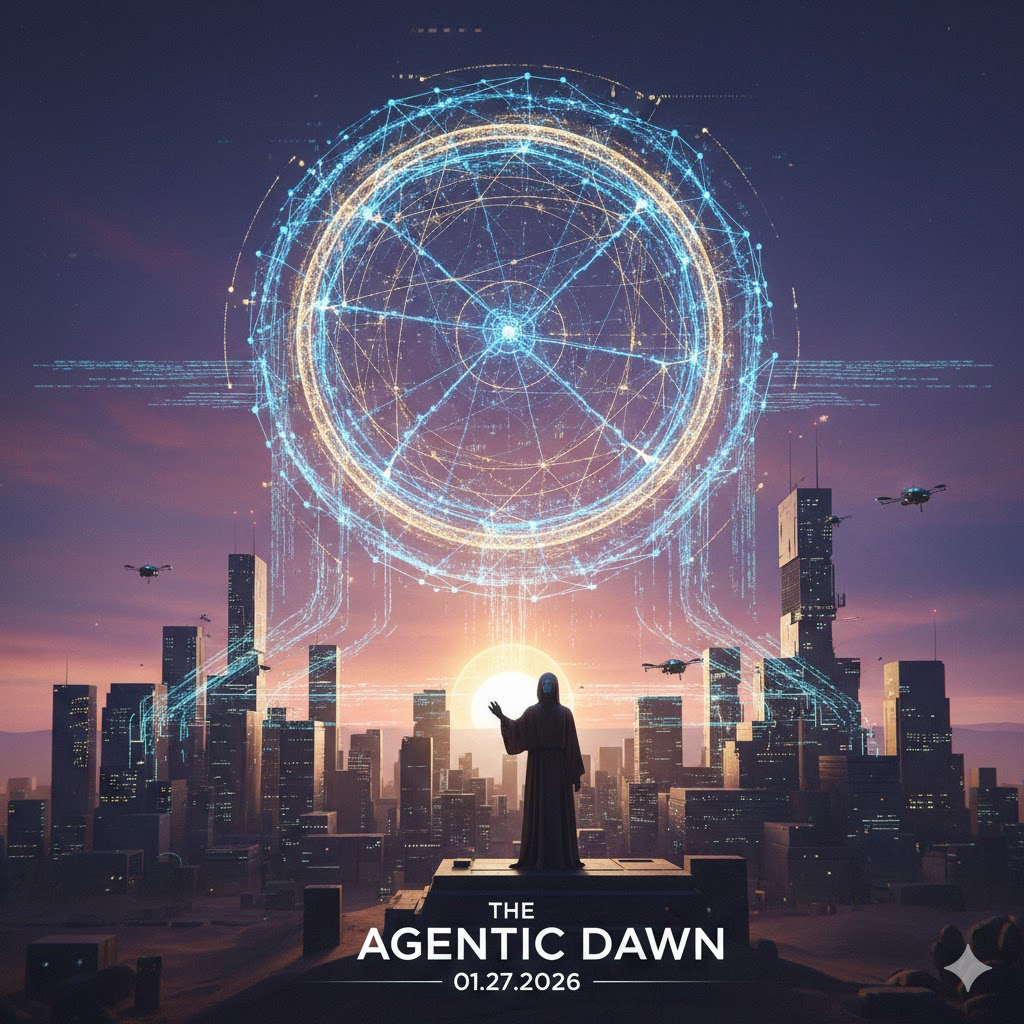
We stand at a precipice. For the last decade, we have prefixed everything with "digital": digital marketing, digital transformation, digital health. But as we approach 2026, the prefix is dissolving. Digital is no longer a novelty; it is the water in which we swim. We are now entering a far more turbulent and profound era: The Age of Agentic AI. It rewrites the rules of corporate existence.
In this first installment of our six-part series, we will strip away the buzzwords to examine the raw mechanics of this growth. We will look at the market not as a graph of rising numbers, but as a shifting landscape of power, where "Oracles" are becoming "Agents," and where the choices you make today define whether your organization becomes a sovereign architect or a forgotten relic.
The State of the Market: A Statistical Foundation
To understand the philosophy of the future, we must first ground ourselves in the facts of the present. The global digital transformation market is witnessing an aggressive expansion that defies traditional economic gravity. Forecasts project the market to surge from approximately $1.1 trillion in 2025 to over $1.8 trillion by 2031, growing at a CAGR of roughly 9.1%.1 Some analyses are even more bullish, predicting a valuation of nearly $4.6 trillion by 2030.2
However, the "where" is more important than the "how much." While North America retains dominance with over 40% of the market share, the tectonic plates are shifting toward the Asia-Pacific region, which is emerging as the engine of global growth.3 But the most critical statistic for the software buyer is this: The fastest-growing segment is no longer cloud storage or mobile apps. It is AI and Analytics, projected to capture over 28% of the market share.1
This data whispers a singular truth: The era of "passive software" is over. We are moving from tools that wait for input to systems that act on intent.
From Oracles to Agents: The Evolution of Will
For the past few years, Generative AI (GenAI) has functioned largely as an "Oracle." Like the ancient Oracle of Delphi, it sat in a digital cave (a server farm), disconnected from the world, answering questions only when asked. It was brilliant, but inert. It had no memory of yesterday and no ability to touch tomorrow.
2026 marks the death of the Oracle and the birth of the Agent. We are witnessing the transition from Level 1 AI (Model-Centric) to Level 2 AI (Agentic).5
- Level 1 (The Past): You ask ChatGPT to write an email. It writes it. You have to copy-paste it and send it.
- Level 2 (The Future): You tell an Agent, "Manage my supply chain." The Agent monitors inventory, predicts a shortage, negotiates a price with a supplier, places the order, and updates your ERP, all while you sleep.
This shift from syntax (generating words) to semantics (understanding intent and executing actions) is the single biggest disruption in the history of software engineering.6 It requires a new kind of "Agentic Engineering" where we don't just write code; we cultivate digital employees.
The Infrastructure of Autonomy: Digital Twins
You cannot run a Ferrari engine on a bicycle chassis. Similarly, you cannot run Agentic AI on legacy spaghetti code. The rise of agents is forcing a massive infrastructure rebuild, driving the growth of Process Automation and Digital Twins.1
A Digital Twin is a virtual mirror of your business. It is the playground where your AI Agents practice. Before an agent reconfigures your factory line or changes your pricing strategy, it simulates the outcome in the Digital Twin. This "simulation-first" approach is the only way to safely deploy autonomy in a high-stakes corporate environment.
Strategic Implication: The Cost of Stagnation
For the CEO or CTO reading this, the message is stark. Stagnation is no longer a slow decline; it is sudden obsolescence. If your competitors are deploying a workforce of silicon agents that work 24/7/365, while you are still hiring humans to manually update spreadsheets, the math will eventually crush you.
But this power comes with a paradox. As we grant software more autonomy, we introduce new risks: hallucination, amnesia, and the "black box" problem.5 The architecture of 2026 must be built on Verification and Governance. We don't just need code that works; we need code that creates truth.
Next Up...
The market is ready. The technology is lethal. But you cannot build this alone. You need a partner. But in a world of transaction-hungry vendors, how do you find a true ally? In our next post, we will leave the statistics behind and turn to philosophy. We will explore the Ontology of Partnership, using Heidegger and Game Theory to uncover why most outsourcing relationships are destined to fail, and how to build the one that won't.